Showing posts with label W is for Whetstone. Show all posts

30 July 2013

The Interestings - Meg Wolitzer


I  became the eleventy-billionth person in line to read this after reading Book Riot’s article about the best books published in 2013 so far. Amanda liked it a lot, and since I’m quite fond of Amanda, I was extremely smug to find it on the Infamous 7-Day Shelf at the library.

Who's smug now?

Five pages in, I was So. Fucking. Charmed. By this book. How can one not be, with this description of growing up?

Irony was new to her and tasted oddly good [...] Soon, she and the rest of them would be ironic much of the time, unable to answer and innocent question without giving their words a snide little adjustment. Fairly soon after that, the snideness would soften, the irony would be mixed with seriousness, and the years would shorten and fly by.
It's all so true.

But ALAS and ALACK, it was all downhill from there, and by page 82 I was gonna give it one more night to prove itself worthy – by which I mean show that it has a plot I could get behind - when my cat attacked The Golden Mean for no reason whatsoever and I picked that up instead and well, you know what happens when serendipity comes a-knocking (things off of your nightstand).

Reader, I started it.

There was a time when I was somewhat judgmental of people who didn’t finish books. “I just HAVE to finish them, even if they’re bad!” I would say, with a serious case of Humblebrag. But much like my opinions about What Kids Should Read These Days, I have abandoned that paradigm for a new one, which is that life is too damn short to read books you don’t enjoy.

And thus did I DNF The Interestings for being… uninteresting.


But seriously, you guys, I have An Issue with the genre of contemporary literary fiction. I go into it all excited for plot twists and good writing and WHOA did you see that clever metaphor go by? But instead, I feel awkwardly like I’m reading someone’s exceedingly pretentious, self-aware diary from when they were a smarter-than-most-adults teenager.


Remind me of this next time we’re on gchat and I get all excited about a book that isn’t a part of the Modern Library reprints or doesn’t have a dragon/spaceship (maybe a DRAGON SPACESHIP?!? Helloooo, Anne McCaffrey!) on the cover, okay?

21 May 2013

The Way of Kings - Brandon Sanderson


This is the tale of a teenaged girl who fell in love with books with dragons on the covers. One day, after having finished everything Melanie Rawn had written and also having been enraged about the ending of The Ruins of Ambrai, someone handed her a 500+ page mass-market paperback that said “Volume 1” on the spine.

Roughly four thousand pages later, she emerged from book six, blinked a bit, and groped around blindly for book seven.

But alas, book seven had yet to be published! And, as it happens, neither had books eight through twelve fourteen. On that day in a sunny bedroom in Alaska in a room with a strange-if-you’re-not-a-teen mixture of kittens and pop stars on the walls, she vowed that she would not read another word of the Wheel of Time series until it was finished, because Robert Jordan would probably die before the damn thing was done.

And thus it was with sorrow but also a small degree of


 that I heard of Robert Jordan’s death before the ending of The Wheel of Time. But lest you think I am too high on my horse, allow me to tell you that I’m current with A Song of Ice and Fire, and there’s no end in sight for that one either.


I love me some epic fantasy, is what I’m trying to say. For years it was the brain candy I used to take my mind off of studying, or in between stints worshipping at the feet of Anthony Trollope or Edith Wharton. These days, most of my book recommendations come from the other book blogs I read, and it’s safe to say that there are not a lot of dragons flying around the covers of their books.

My friend Jeremy also loves fantasy and sci-fi, and since we occasionally share a brain, he suggested I read The Way of Kings. What he neglected to tell me was that this is the first book of a series of ten, and that only this one has been published so far.

WILL SHE EVER LEARN NO I DON'T THINK SO.
You’d think the guy who was commissioned to write the end of Wheel of Time would be a little leery of planning at 10,000+ page series, wouldn’t you?  BUT NO. He cares not for fate and her wily ways.

Anywhatsis, if you like this kind of thing – that is, epic, world-building stories that could reasonably be used as weights and take a torturously long time to get written and published – this is pretty close to as good as it gets. 

8.5 of 11 Glowy Rocks to be Used as Currency

09 April 2013

Who Could That Be at This Hour? - Lemony Snicket


Have you read A Series of Unfortunate Events? You should. It’s clever and fun and sad and lovely all at the same time. I’m not generally a huge fan of things aimed at middle-grade kids, but for Lemony Snicket, I will always make an exception. Which explains why I snatched this book off of the 7-Day Loan shelf right in front of some middle-grade child and ran away, cackling with glee.


I love you, Ru.

Who Could That Be at This Hour? starts with our Lemony having just graduated from school at the tender age of 12. One of the most brilliant things about this author is his willingness to leave large swathes of information out of the text, thereby leaving them up to the reader to fill in. He fills the void that was created when Harry Potter ended; you know the one – the thing where I learned to grasp at every tiny shred of information like a murder victim snatching at her attacker’s hairs to provide some clue as to whodunit.  

Story! Snicket has reason of his own for choosing S. Theodora Markson – dead last on the list of 52 - as his official chaperone, but to his great surprise she takes him out of town to a village called Stain’d-by-the-Sea, where the sea itself is no longer nearby and the major revenue comes from rapidly drying pockets of octopus ink.

The story gets odder and more entertaining from there, and as always I’m disarmed by the word-play and sly references:

“There’s an easy method for finding someone when you hear them scream. First get a clean sheet of paper and a sharp pencil. Then sketch out nine rows of fourteen squares each. Then throw the piece of paper away and find whoever is screaming so you can help them. It is no time to fiddle with paper.”

“Do you know how to pick a lock?”
“Not really,” I said, “I received a grade of Incomplete. I know how to throw a rock through a window.”


“I’m reminded of a book my father used to read me,” she said. “A bunch of elves and things get into a huge war over a piece of jewelry that everybody wants but no body can wear.”
“I’ve never liked that kind of book,” I replied. “There’s always a wizard who’s very powerful but not very helpful.”


In conclusion, Lemony, I would like to go to your school and have adventures with you. And I promise not to steal your weird little statue.

7.5 of 11 Typewriters on the Stairs

20 December 2012

Alif the Unseen by G. Willow WIlson


This is a curious little book - and yes, I tend to consider anything under 500 pages "little" because this is Reading the Bricks, not Reading Some Thin Things. Keep up!

Alif is the hacker name of a kid in an unmentioned Middle Eastern town who gets dumped by the upper-caste girl he was in love with and writes a computer program to identify her "signature"-  that is, not just her ISP and other internetty things, but there's a keylogger that figures out her keystroke pattern and over time learns to identify her based on her syntax.

In other words, he creates a program that is essentially AI, and then the Government hears about it and gets ahold of it and they try to start using it to find hackers. Which is TYPICAL, Big Bad Governmental Propaganda Machine, and you should stop doing that! Information wants to be figuratively free!


Sidebar: my boss recently told me that "information literally wants to be free." To which I smiled and nodded because if I'd opened my mouth at that particular moment I might have figuratively died on that grammatical hill. In retaliation that seems to be taking the form of torturing only me, I've started over-using the word "figuratively." So, I apologize in advance. Literally.

G.Willow Wilson has a way with ideas, my friends. As in her way, if you knowwhutImean.
"Dear Nurse, as much as I love you, you are terribly muddled when it comes to the morals of stories."
"Dear child, some stories have no morals. Sometimes darkness and madness are simply that.
"How terrible," said Farukhuaz.
"Do you think so? I find it reassuring. It saves me from having to divine meaning in every sorrow that comes my way" (139).

Just think about that for a minute. If we accept the nurse's first premise, then we can accept the second - and I can share with you from experience that accepting the second premise makes life much more bearable - not to mention self-centered.

But she's unexpectedly sly, too:

"You have that sullen expression young men get when they've been jilted. It's why men are meant to have beards - growing all that hair leaves no energy for moodiness. Much more dignified" (190). 
Dignity.
And lastly, a girl whose sense and responsible nature we can all get behind:

"No," said Dina. "We don't burn books."
"Who's we?"
"People with an ounce of brain." 

Renly Baratheon would probably not burn books either. Too bad he dies.

The thing that struck me most about this book is how not Western-centric it was. As if people who aren't Westerners generally don't give two figs about us - which is an interesting reminder that the bulk of the world will never read ANY of the books I've read, simply because there are books originally written in their own languages that are more important to them. How can Middlemarch and House of Mirth not be important to everyone?

That is so weird, you guys.

8.5 out of 11 Djinn Posing as Mob Leaders in your Home Town


05 November 2012

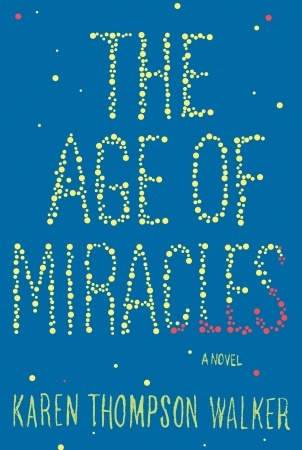
The Age of Miracles - Karen Thompson Walker


There is this thing publishing has started doing in the last *mumblemumble* years where they call a first novel a debut novel. This always makes me think of débutantes dressed in white, swanning their way down stairs on their fathers' arms so they can be introduced to society, and I kind of hate it.

Firstly because there's suddenly all this pressure to make your début novel amazing, which only happens if you're Susanna Clarke or Harper Lee or Margaret Mitchell, which you are not. And secondly because it puts unrealistic expectations on the book to be HAAAA-mazing and flawless, which is hard enough for a seasoned writer, much less a débutante  And if there's one thing I will do when I'm expected to find a book to be flawless, it's... find a fuckton of flaws.


Julia is 11 when the world starts slowing on its axis. Days gain hours, and while it's kind of a thing, it's not really because she's eleven and has other stuff to worry about, like being the weird kid at the bus stop and liking the handsome skateboarder guy.

Now I'd like you to please pause and think about what you knew when you were eleven. If the answer is "almost nothing," then you are in the same boat as me and the rest of society. Julia, however, is outside of this boat. She's already made it to Adult Reflections Land, where people say things (to themselves) like,

"Carlotta's long gray hair swung near her waist, a ghost, I suspected, of its younger and sexier self" (p. 106).
Reeeeally.
Look, KT-Dubs, I dunno how long it's been since you were eleven, but I have a 12-year-old brother and I am here to tell you that considering the ghosts of people's formerly sexy hair is not on that age group's radar. AT ALL.

The narrator could have been 19, or 25, or 47 years 3 months and 7 days, because she's speaking through an adult mouthpiece - which I haaaaaaated. And I get that this is a coming-of-age novel, wherein the heroine Learns Lots of Things and Puts Away Childish Ideas, and that it's sad that she has to do that while the world is ending (slooooowly). And when there's a concept as fascinating as the Earth slowing its roll, it seems almost wasteful to overlay it with the everyday issues of a pre-teen girl, which to those of us who are no longer pre-teens are about as exciting and urgent as getting you car washed during the rainy season.

This would have been sooooooer much better as a short story or a novella. Cut 150 pages, throw a couple of other short stories on top about other people in this world, call it a collection and BOOM! Better.

Also because I don't read short stories, and thus wouldn't have read it or felt left out for skipping it.

4.5 of 11 Stockpiles of Apocalypse-Friendly Foodstuffs

23 October 2012

Code Name: Verity - Elizabeth Wein


One of the reasons I don't tend to read mysteries is that I like to talk about plot, and it's difficult to do so when one-third of a book is about "Lo, a mystery!" and the other two-thirds are about "Let's solve this (preferably with witty banter and possible sexytimes, a la Castle and Bones)!" And then one has to dance around the plot, not Giving It All Away, much like a great aunt warning you against sexytimes of your own while "Will You Still Love Me Tomorrow" plays sadly in the background.

And while this book is not a mystery, it presents many of the same discussion difficulties that a mystery might.


This book is...

I want to talk about...

And then there's this other thing...


Well, there is ONE thing I want to talk about. This book is set in the 1940s in England (mostly), and it's written in the first-person, which means that the characters should speak as if they were in that time period. And if I am not very much mistaken - which I am not - the convention of speaking forcefully being expressed in ALL CAPS, shouty-internet style, is fairly recent.

I know that complaining about all-caps usage by an author makes me a huge hypocrite. Trust me, I'm aware.

But it bugged me.

Especially because I tend to read sentences in all caps in a very specific type of shouty style - probably due to the book blogging friends I hang out with - which looks very much like this:

"...SO EMBARRASSING..." (p.1)

BUT aside from that, this is a Very Good Book and you should all read it and if I go on much longer I will Give It All Away, which as we've all learned will lead only to singing sad doo-wop tunes in the shower.

The best accolade for this book I can give is this: I think Connie Willis, High Dame of Alternative WWII History, would like it.


9 of 11 Muppet Flails, Aviatrixes!


08 October 2012

The Book of Blood and Shadow - Robin Wasserman


I am compelling and mysterious! There is a shadow in my blood-colored eye! GET IT??
So now I have a library card and the books are starting to filter in - generally too fast for me to read in anything resembling a timely manner according to the library, which also (as it happens) objects to me making notes in the margins of its books. Library, I blame you for my newfound obsession with Post-It page markers. 

Ok, focusing on this book. I enjoyed this book much more than I... well, not more than I expected to. The nice thing about reading a hundred+ book blogs every day with the library request page open is that books just magically appear and I'm pretty sure I'll like them because otherwise I wouldn't have put the book in my queue. But I digress (shocker). I like this book because even though the heroine can translate Latin on the fly, she has a legit reason for learning to do so - and not just because she was home-schooled as a cancer kid (::coughJohnGreencough::).

I do, however, take SERIOUS ISSUE with the teenagers-solving-ancient-mysteries thing. Granted, the author gave us a moderately reasonable story here - information came to light that no one had seen yet, and the kids' professor hoarded it so they knew What Was Up. But still; as a general rule, I am almost as tired of this trope as I am of the two-rockin'-guys-one-clumsy-girl love triangle (TwilightandHungerGamesIamlookingatYOU!)

Make no mistake, there are many things Wasserman did right here. The aaaaaaangst of teenaged love is hard to watch, even when the participants to speak fluent Latin (unlike me who has had Wheelock's and sundry workbooks for years to no avail...). A few lines stuck out to me, and this one in particular:

"So Thomas had left her behind, alone. She had given him her heart and, apparently, he'd taken it with him as a parting gift." (p. 72)
Girl, I have BEEN THERE.
And then there's this totally legit point about how the author of the letters was writing 3 years post- Romeo and Juliet, and how can she accurately describe love without books like Pride and Prejudice or Gone with the Wind (not actually a love story)? Which makes me think that there must have been some equivalent that is lost to the ravages of time, so what were they? 

There's a buncha stuff that happens that I enjoyed but I can't tell you about because

(Alice that one's for you)
 But I liked it and you probably will too. 


7.5 of 11 Latin Translations (the hilarious dirty kind)


17 September 2012

The Little Stranger - Part the Second

This read-a-long brought to you by The Estella Society, which is awesome: 


Four hundred sixty-three pages later and I am... seriously underwhelmed.

First, let me say that I read through a lot of the first round RAL posts over at The Estella Society, and I think those people maybe read a different book than I did? Because their reviews were full of praises for the characterization and the creep factor and the slow build of the characters' interpersonal relationships, and (as you may be aware) my review was full of Whoopi Goldberg gifs and what-am-I-missing-guise?!?

For those of you new to this place - which is pretty much everyone since this blog is only a month and a half old - I promise you that I know A Lot about plot and watching slow characterization and that I can use all the Big Literary Words and once got 100% on a paper about how the City of London was a legit character in The Old Curiosity Shop. But let's face it: gifs are funnier, and everyone needs a niche.

SO. Let's talk about how this book is basically the literary equivalent of:


So I guess titular character was only ever after the family? Which is weird because they never really talked about it, or when they did someone got chucked into an asylum. And also un-scary because I didn't really care about the family much, and since I'm NOT the family, I'm safe. Safety is the antithesis of fear. And then Doctor Faraday convinced himself that he was in love with Caroline, which isn't really true because obvs. he wanted Hundreds - weird shit and all. And THEN Mrs. Ayres goes and hangs herself on a doorknob (?) because why not leave the woman with spontaneous body-stigmata all alone? Surely nothing could happen to her!

The Aunts KWIM.
And then Caroline calls off the wedding to Dr. Faraday because she never loved him after all, which I COULD HAVE TOLD HIM based on her behavior, and THEN she jumps/is pushed off of a balcony in her house and dies, too, because she thinks The Thing in the house is done with her family maybe, so getting up in the middle of the night is safe?  This is All So Sad, but from one event to the next, there's no sense that the next person should GTFO and move to sunny Spain and spend the rest of their lives tilting at windmills.

(My favorite metaphors are mixed ones.)

Herein lies my ISSUE with this book: I got no sense of looming danger, no sense of frenetic AGGHGHHHHHH for me-the-reader, no sense that the thing in the house is truly malicious or even really dangerous. The Doctor got more and more repugnant as he pushed and pushed his wedding to Caroline, and really in the end I felt like everyone deserved what they got, which (while allowing me to feel very smug) is probably not the way Waters intended me to feel. Witholding information from the reader can be extremely effective, but in this case there was too much witholding; not enough detail got through to incite fear or dread.

I will say, though, that I enjoyed the read-a-long itself very much, and am looking forward to more with The Estella Society!

4 of 11 Victorian speaking tubes, and a mandatory viewing of Arsenic and Old Lace for anyone who doesn't recognize the Aunts.


BONUS LIST OF Things that Do Suspense Better than This Book:

Rebecca by Daphne du Maurier
The Haunted Mansion at Disneyland
My cat about to pounce on something
The doorbell when you don't know who's coming over


10 September 2012

The Little Stranger - Part the First


This read-a-long is brought to you by The Estella Society, which is amazing and about which I am very excited. 


I don't read scary stories because I hate being scared. Haaaate it. This irritates the crap out of my brothers, but it's probably their fault since they liked nothing better when we were young than to jump out at me and make me scream like the little girl I was. Horror movies are Right Out; I had to be convinced by at least 3 other people - also avoiders of scary - that Cabin in the Woods (2011) was something I'd like, and even then I took a boy I could clutch in times of distress (I did like it, by the way, despite the boy turning out to be sub-par. You probably would, too).

You know how sometimes you have to revisit things to see if you still hate them? Like Brussels sprouts or fish or chardonnay? This read-a-long is me figuring out whether I still hate scary stories.

And guess what? I STILL DO.

I hate the creeping fear, I hate the gnawing dread, I hate that characters haven't read the blurb on the back of the book so they don't know they're living in a scary story so they do things like go down into the basement or up into the attic or insist on living in a mouldering old wreck of a CLEARLY HAUNTED HOUSE.


So there's this family living in a Clearly Haunted House, and they're Barely Hanging On because it's post-WWII Britain and everyone's still on rationing and the gentry are all a-wail because their parks are being broken up and they have to sell their five zillion horses, boo hoo. And in comes the Good Doctor character, our narrator, who has no premonitions, no precognitions, no nothing! As a good doctor should, but as a Good Scary-Story Narrator should most definitely not. He's a bit of a jerk, really, and I don't much like him. So there.

And shit starts happening and of course the servant figures it out first because servants are the Salt of the Earth and all. But does anyone listen to poor little Betty? NO THEY DO NOT. So I'm laying in bed reading this and getting alternately terrified of finding little black marks on my walls and annoyed with everyone in the book for being so veddy, veddy stiff-upper-lip English and practical.

And also sugar and petrol rationing. 

Sarah Waters, I miss your lesbian sexytimes, but I will finish this because I have to know what (if anything) will happen so I can sleep at night and also I have the palette-cleansing Tipping the Velvet in my TBR pile. It turns out that when you actually go into the stacks at the library instead of just from the door to the hold shelf to the checkout machine, there are other books for you to read!

Technology, you make me lazy.